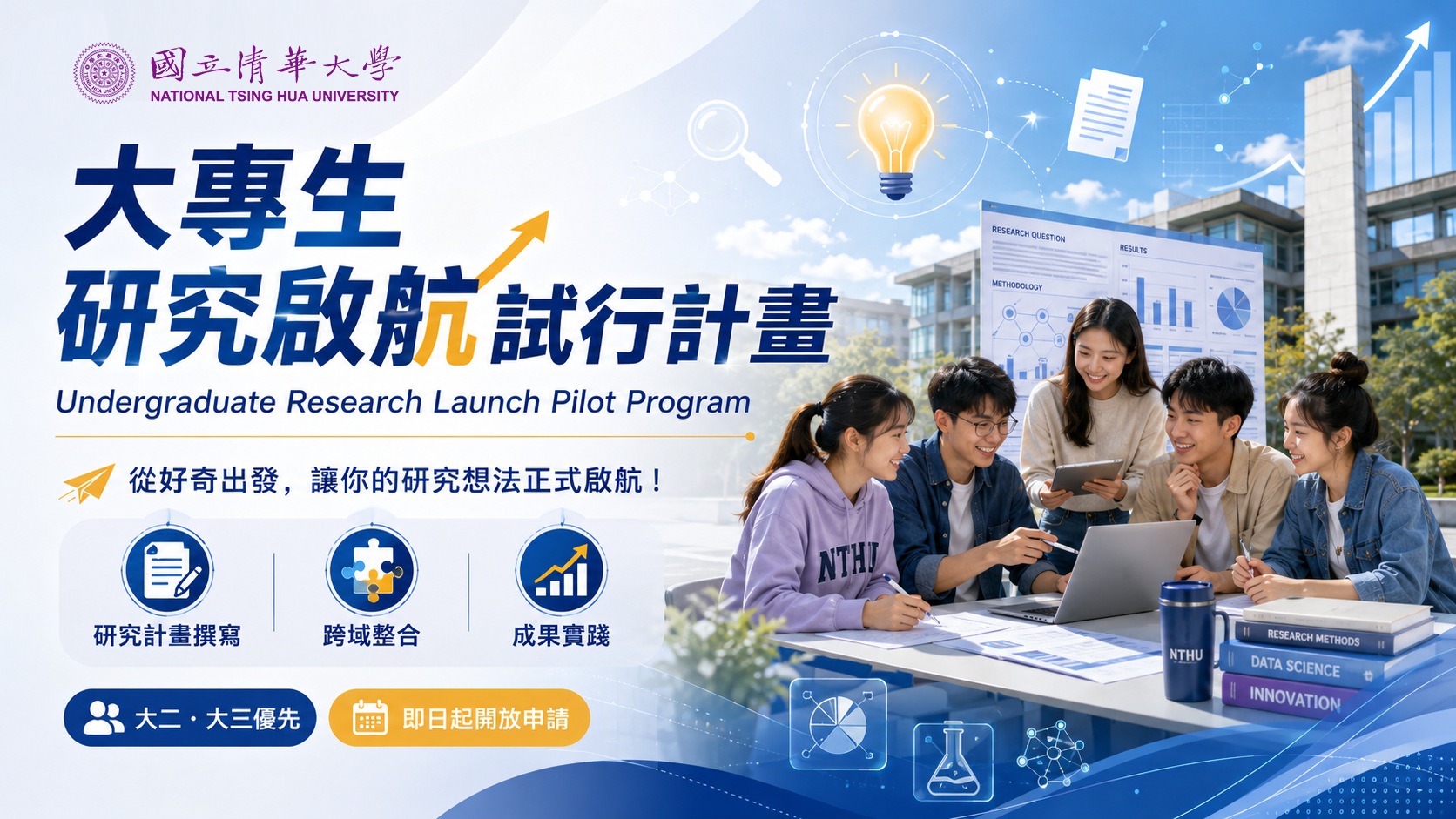
【大專生研究啟航試行計畫】你的第一份研究計畫,從這裡開始!大專生研究啟航試行計畫徵件中 Start Your First Research Project Here! Undergraduate Research Launch Pilot Program Now Open for Applications
你是否曾經在課堂中對某個問題感到好奇?
是否有過一個想深入探究的主題,卻不知道該怎麼開始?
或者,你其實想嘗試申請研究計畫、參加專題競賽,卻還沒有完整的計畫書?
別擔心,研究不一定要等到研究所才開始!🚀
國立清華大學教務處教學發展中心推出「大專生研究啟航試行計畫」,鼓勵本校學生及早接觸研究活動,從一份研究計畫書開始,培養問題探究、資料蒐集、研究規劃與計畫撰寫能力,為未來申請校外研究計畫、專題競賽或相關徵件累積經驗。
本計畫以大二、大三學生為優先,歡迎對研究有興趣、已有初步題目想法,或想挑戰校外研究計畫與專題競賽的同學踴躍申請。只要你願意從一個問題開始,嘗試把想法整理成研究計畫,這就是你的研究啟航點!
🌱 為什麼教發中心推動大學生研究經驗?
大學學習不只是修課、考試與完成作業,更重要的是學會如何發現問題、整合知識,並把自己的想法轉化為具體成果。
教發中心希望透過「大專生研究啟航試行計畫」,協助學生從課堂中的好奇出發,逐步建立研究計畫撰寫、資料蒐集、批判思考、跨域整合與成果表達能力。
🔍 從探索走向深化
許多學生對跨領域議題、社會現象或科技應用充滿興趣,但若缺少研究訓練與引導支持,學習容易停留在「有興趣」或「初步探索」階段。本計畫希望協助學生把好奇心進一步轉化為可執行的研究問題與計畫。
🧩 從跨域走向整合
跨領域學習不只是修習不同領域的課程,更需要練習如何整合知識、提出問題、設計方法並產出成果。透過指導教授陪伴與階段性任務,本計畫希望幫助學生累積更完整的整合性學習經驗。
🚀 從想法走向成果
本計畫鼓勵學生將研究成果銜接校外研究計畫、專題競賽或相關徵件,讓原本在課堂中萌芽的想法,有機會被整理成具體成果,並成為未來升學、專題、競賽或職涯發展的重要養分。
✨ 面對 AI 時代與未來職場變化,學生更需要培養高階能力。 包含問題定義、批判思考、跨域整合、專案管理、創造力、適應力與研究能力等。 教發中心期待透過本計畫,陪伴清華學生從探索走向整合,從興趣走向能力,從跨域走向創新。
✨ 計畫特色
一、從零開始,練習研究計畫撰寫
不需要一開始就有完整成果,本計畫重視的是你的問題意識、研究構想與執行規劃,協助你逐步建立研究能力。
二、指導教授陪伴,讓研究更有方向
申請者須邀請指導教授協助指導研究計畫,透過討論與修正,讓研究主題更加清楚、執行方式更加可行。
三、銜接校外計畫與專題競賽
本計畫鼓勵學生將研究成果進一步銜接政府機關、私人企業、基金會所辦理之研究計畫、專題競賽或相關徵件,讓研究想法有機會走出課堂。
四、獎勵金與研究經費支持
通過審查及完成各階段任務者,可依規定獲得獎勵金、研究執行經費補助及獎狀,支持同學踏出研究的第一步。
🎯 申請對象
國立清華大學在校學生,並以115學年度之大二及大三學生為優先。
📝 申請方式
請於公告期限內完成線上申請,並依規定繳交相關申請資料。
申請者請先下載並填妥「計畫申請表」,完成申請人及指導教授簽名後,將已簽名之申請表掃描為 PDF 檔,再至 Google 表單填寫線上申請資料並上傳該 PDF 檔。
📅 計畫期程
| 申請期間 | |
|---|---|
| 審查與公告 | 115/10/05 |
| 計畫執行及核銷截止日期 | 自核定日起至 115/11/16 |
| 成果繳交期限 | 115/12/01 |
💰 獎勵與補助
第一階段
研究計畫書經審查通過者,核發獎勵金新臺幣 1,000 元。
第二階段
計畫執行期間,每案最高補助研究相關經費新臺幣 2,000 元。
第三階段
學生完成 12 月初成果報告繳交,並於翌年 3 月底前繳交參與校外甄選計畫之內容及送件證明,經審核通過後,核發獎勵金新臺幣 2,000 元及獎狀一紙;指導教授亦得頒發感謝狀一紙。
📌 成果繳交
錄取學生須於計畫執行期間完成研究規劃與執行,並至少繳交兩次與指導教授研究討論之紀錄或相關佐證資料。
計畫完成後,學生須於規定期限內繳交成果報告,內容包含參加校外甄選之計畫摘要及送件證明。
🙋 適合誰申請?
如果你符合以下任一情形,都很適合申請本計畫:
- 對某個課堂主題、社會現象、科技應用或實務問題感到好奇。
- 想嘗試寫研究計畫,但不知道從何開始。
- 未來想申請國科會大專學生研究計畫或其他校外研究補助。
- 想參加專題競賽、研究徵件或跨領域實作計畫。
- 希望在大學早期累積研究經驗,為未來升學、專題或競賽做準備。
研究的起點,往往不是一個完美答案,而是一個你真正在意的問題。
歡迎有興趣的同學把握機會,讓你的研究想法正式啟航!
📬 聯絡方式
國立清華大學教學發展中心 郭欣妤博士
校內分機:35403
E-mail:kuohy@mx.nthu.edu.tw
Have you ever felt curious about a question raised in class?
Have you ever wanted to explore a topic more deeply, but were not sure where to begin?
Or have you thought about applying for a research program or joining a project competition, but did not yet have a complete research proposal?
Don't worry — research does not have to wait until graduate school! 🚀
The Center for Teaching and Learning Development, Office of Academic Affairs, National Tsing Hua University, is launching the “Undergraduate Research Launch Pilot Program” to encourage students to engage in research activities at an earlier stage. Starting with a research proposal, students will have the opportunity to develop their abilities in problem exploration, data collection, research planning, and proposal writing, while building experience for future applications to external research programs, project competitions, or related calls for proposals.
This program gives priority to sophomore and junior students. Students who are interested in research, already have a preliminary research idea, or wish to challenge themselves by applying for external research programs or project competitions are welcome to apply. If you are willing to start with a question and turn your ideas into a research proposal, this is your starting point.
🌱 Why is the Center promoting undergraduate research experiences?
University learning is not only about taking courses, passing exams, or completing assignments. More importantly, students need opportunities to discover meaningful questions, integrate knowledge, and turn their ideas into concrete outcomes.
Through the Undergraduate Research Launch Pilot Program, the Center for Teaching and Learning Development hopes to help students begin with curiosity and gradually develop skills in proposal writing, data collection, critical thinking, interdisciplinary integration, and research presentation.
🔍 From exploration to deeper inquiry
Many students are interested in interdisciplinary issues, social phenomena, or technological applications. However, without research training and guidance, learning may remain at the level of initial exploration. This program helps students transform curiosity into researchable questions and feasible project plans.
🧩 From interdisciplinarity to integration
Interdisciplinary learning is more than taking courses from different fields. Students also need to practice integrating knowledge, defining problems, designing methods, and presenting outcomes. With faculty guidance and staged tasks, this program supports students in building a more complete integrative learning experience.
🚀 From ideas to outcomes
The program encourages students to connect their research outcomes with external research programs, project competitions, or related calls for proposals. Ideas that begin in class can be developed into concrete outcomes and become valuable experience for future study, capstone projects, competitions, or career development.
✨ In the age of AI and rapid workplace transformation, students need to cultivate higher-order abilities. These include problem-finding, critical thinking, interdisciplinary integration, project management, creativity, adaptability, and research skills. Through this program, the Center hopes to help NTHU students move from exploration to integration, from interest to competence, and from interdisciplinarity to innovation.
✨ Program Features
1. Start from scratch and practice writing a research proposal
You do not need to have complete research results at the beginning. This program values your research questions, project ideas, and implementation plan, and aims to help you gradually build your research skills.
2. Faculty guidance to help shape your research direction
Applicants are required to invite a faculty advisor to guide their research project. Through discussion and revision, students can clarify their research topic and develop a more feasible implementation plan.
3. Connection to external research programs and project competitions
This program encourages students to further connect their research outcomes with research programs, project competitions, or related calls for proposals organized by government agencies, private companies, foundations, or other external organizations.
4. Incentives and research funding support
Students who pass the review and complete the required tasks at each stage may receive incentives, research-related funding support, and certificates in accordance with program regulations.
🎯 Eligibility
Current National Tsing Hua University students are eligible to apply, with priority given to students who will be sophomores or juniors in Academic Year 115.
📝 Application Method
Applicants must first download and complete the Official Application Form. After completing the form, please obtain the signatures of both the applicant and the faculty advisor, and save the signed application form as a PDF file.
Applicants must then complete the Online Submission Form by the application deadline and upload the signed PDF application form through the online form. Please note that the application will not be considered complete until the applicant has submitted the Online Submission Form and uploaded the signed application form in PDF format.
📅 Program Timeline
| Application period | |
|---|---|
| Review and announcement of results | October 5, 2026 |
| Project implementation and reimbursement deadline | From the date of approval to November 16, 2026 |
| Final submission deadline | December 1, 2026 |
💰 Incentives and Funding
Stage 1
Students whose research proposals pass the review will receive an incentive of NT$1,000.
Stage 2
During the project implementation period, each approved project may receive up to NT$2,000 in research-related funding support.
Stage 3
Students who submit the final report in early December and submit the content of the external selection project along with proof of submission by the end of March of the following year will, upon review and approval, receive an incentive of NT$2,000 and a certificate. Faculty advisors may also receive a certificate of appreciation.
📌 Final Submission
Selected students must complete their research planning and implementation during the project period. They are also required to submit at least two records of research discussions with their faculty advisor or other relevant supporting documents.
Upon completion of the project, students must submit a final report by the designated deadline. The report should include the abstract of the project submitted to an external selection, program, or competition, as well as proof of submission.
🙋 Who Should Apply?
This program is a great fit for you if you:
- Are curious about a course topic, social issue, technological application, or practical problem.
- Want to try writing a research proposal but are not sure where to begin.
- Plan to apply for the NSTC College Student Research Scholarship or other external research funding in the future.
- Want to participate in a project competition, research call for proposals, or interdisciplinary project.
- Hope to build research experience early in your university studies and prepare for future graduate study, capstone projects, or competitions.
The starting point of research is not always a perfect answer, but a question you genuinely care about.
We warmly encourage interested students to take this opportunity and let your research ideas set sail!
📬 Contact Information
The Center for Teaching and Learning Development, National Tsing Hua University
Extension: 35403
E-mail: kuohy@mx.nthu.edu.tw